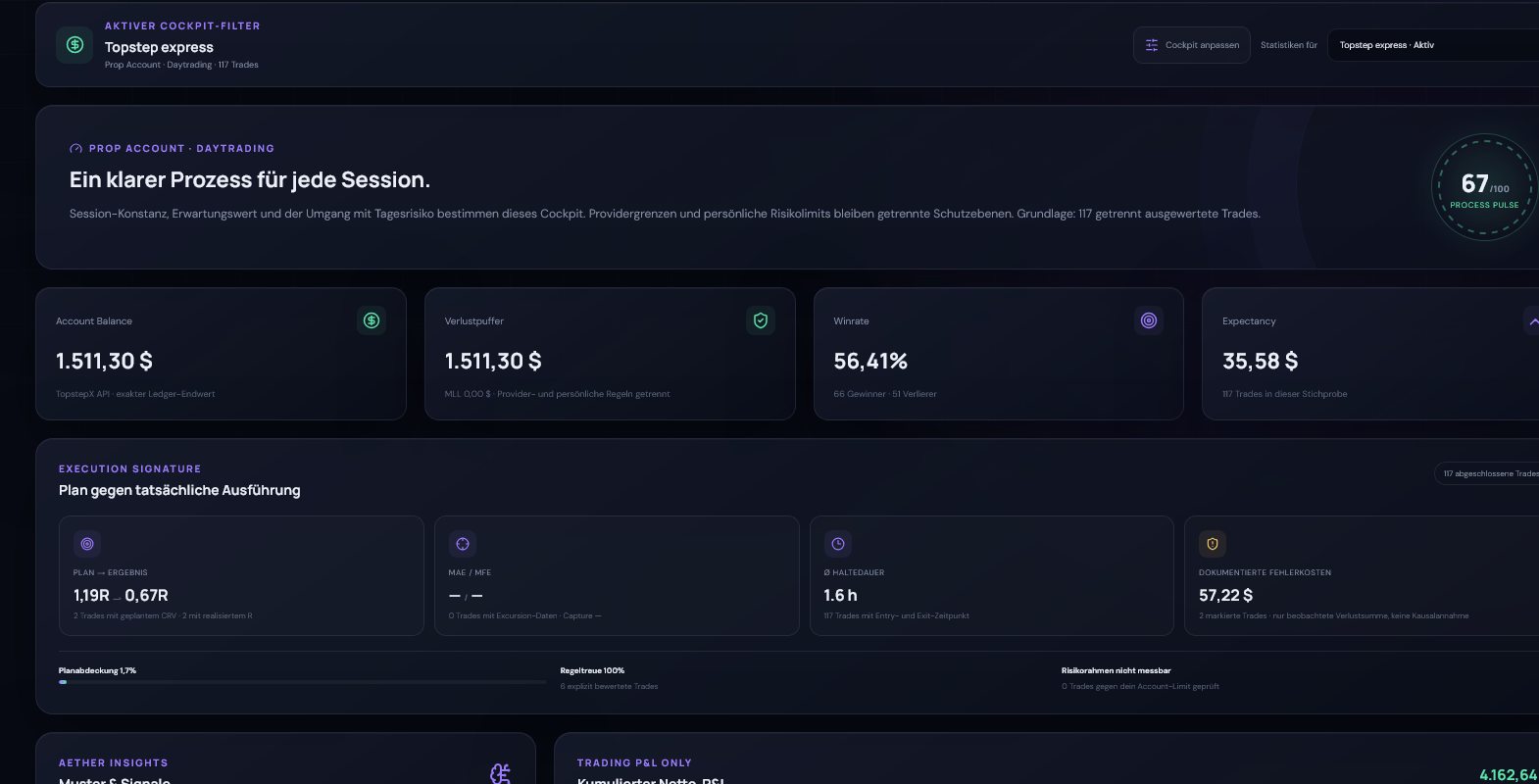
The real problem is not missing data. It is disconnected data.
Most journals begin with a sensible table: date, instrument, direction, entry, exit and profit or loss. That is enough for bookkeeping, but it is rarely enough for learning. The result is visible while the decision process that produced it disappears.
A winning trade can violate the plan. A losing trade can be a high-quality execution. If both are labeled only by outcome, the journal rewards variance and punishes discipline. Over time, that creates the wrong feedback loop.
The fix is not to add dozens of mandatory fields. It is to connect four layers of evidence: execution, market context, decision context and account risk. Each layer answers a different question.
The review ruleNever use P&L as the only label for trade quality. Score the decision and the outcome separately.
Layer 1: Preserve execution truth
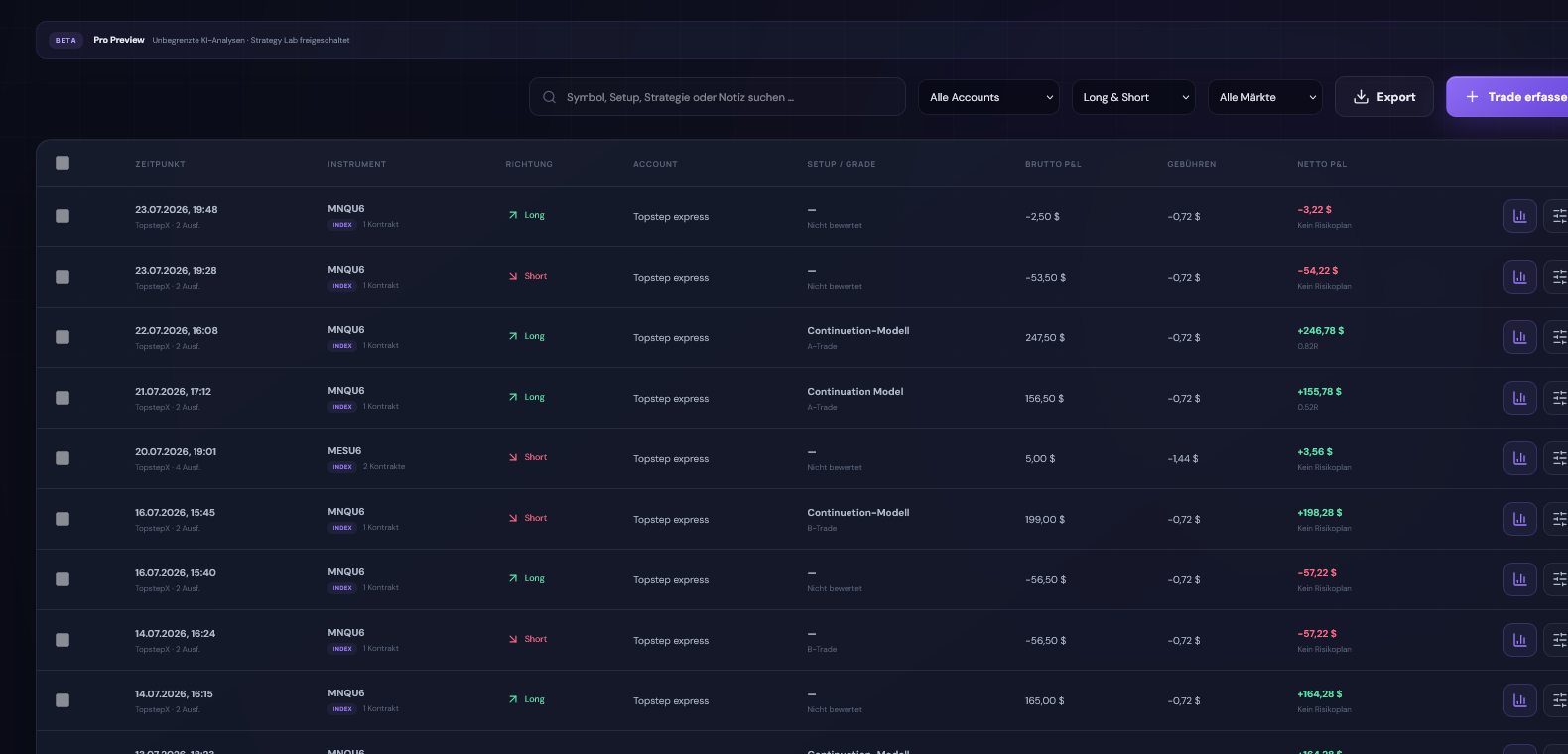
The journal needs a reliable account, side, quantity, timestamp, price and fee record. Futures platforms often export individual fills rather than finished trades, so the journal must reconstruct positions without losing the original source. Corrections and partial exits should remain auditable.
This is where automation matters most. Manual entry is excellent for reflection but fragile for execution data. A read-only API, signed bridge or well-defined import profile reduces transcription errors and leaves more attention for the review itself.
Layer 2: Capture the decision—not an essay
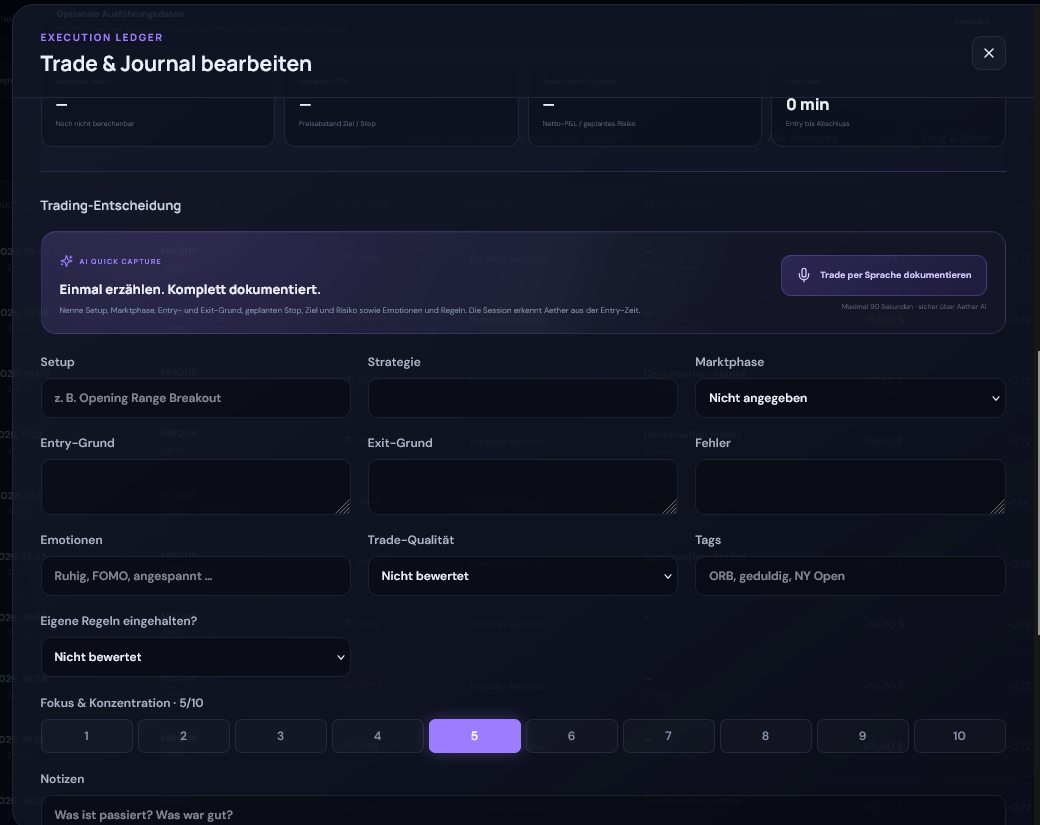
A practical journal captures the setup, entry reason, exit reason, market phase, emotional state, mistake and rule status. The fields should be fast enough to complete after the session and structured enough to filter later.
Voice capture can shorten this step. A trader can describe the trade in natural language, let the system propose structured fields and confirm them before saving. The confirmation step matters: automation should accelerate documentation, not invent certainty.
Layer 3: Track risk in the account where it exists
A balance, drawdown limit or payout cycle belongs to one account. Combining several accounts into one synthetic balance can hide a breach in one account and exaggerate safety in another. The same principle applies to personal capital accounts and prop accounts: their constraints are different, so their risk views must remain separate.
For futures traders, risk review should include more than maximum drawdown. Ask how much was planned, how much was actually realized, whether size increased after a loss and whether rapid re-entry changed the distribution of outcomes.
Layer 4: Analyze a sample, not a story
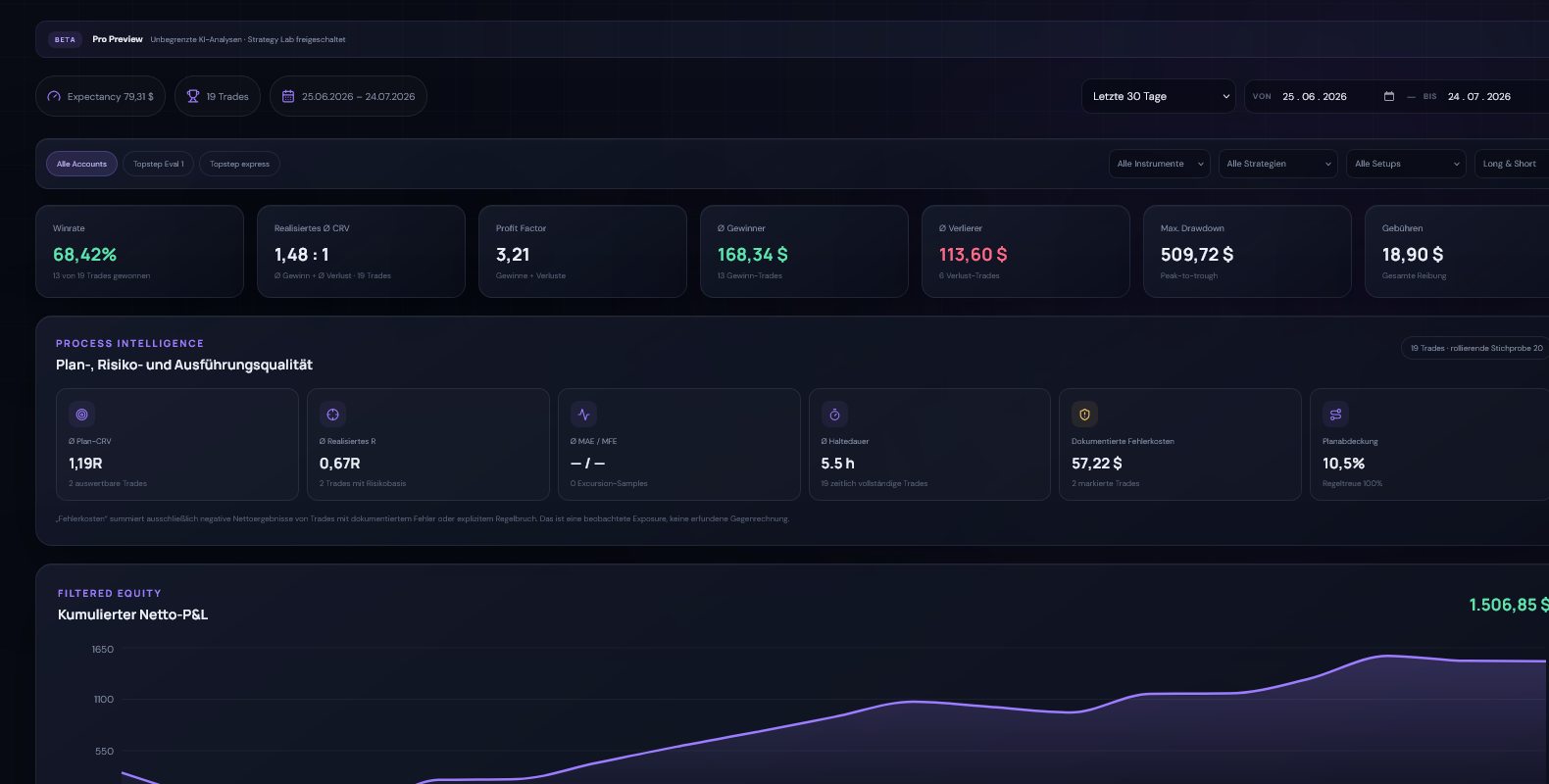
Filters are useful only when the sample size remains visible. A 75% win rate across four trades is not the same finding as 58% across 120 trades. Good analytics keep the date range, account, trade count and costs beside the headline metric.
Start with expectancy, realized R, profit factor, average winner, average loser, drawdown and fees. Then break the sample down by setup, instrument, direction, session and time of day. Finally, return to the journal entries behind an unusual cluster before changing a playbook.
A repeatable 15-minute weekly review
First, verify that all executions are assigned to the correct account and that fees are present. Second, scan the calendar and equity path for unusual days. Third, compare planned versus realized risk. Fourth, open the two best and two worst process scores—not merely the biggest winners and losers. Fifth, write one hypothesis for the next week.
A useful hypothesis is small and observable: “After my first losing trade, I will wait ten minutes before the next entry and compare the next 20 occurrences.” It is more valuable than a vague promise to be more disciplined.
A journal succeeds when it changes the next decision. Everything else is storage.
Sources and further reading
Sources describe the cited evidence, not a promise of future trading performance. Verify time-sensitive provider information in the current official documentation.