Revenge trading is not a clean broker field
A broker can export time, side, size, price and outcome. It cannot export whether a trade came from frustration, conviction or a valid setup. Revenge trading begins as an interpretation.
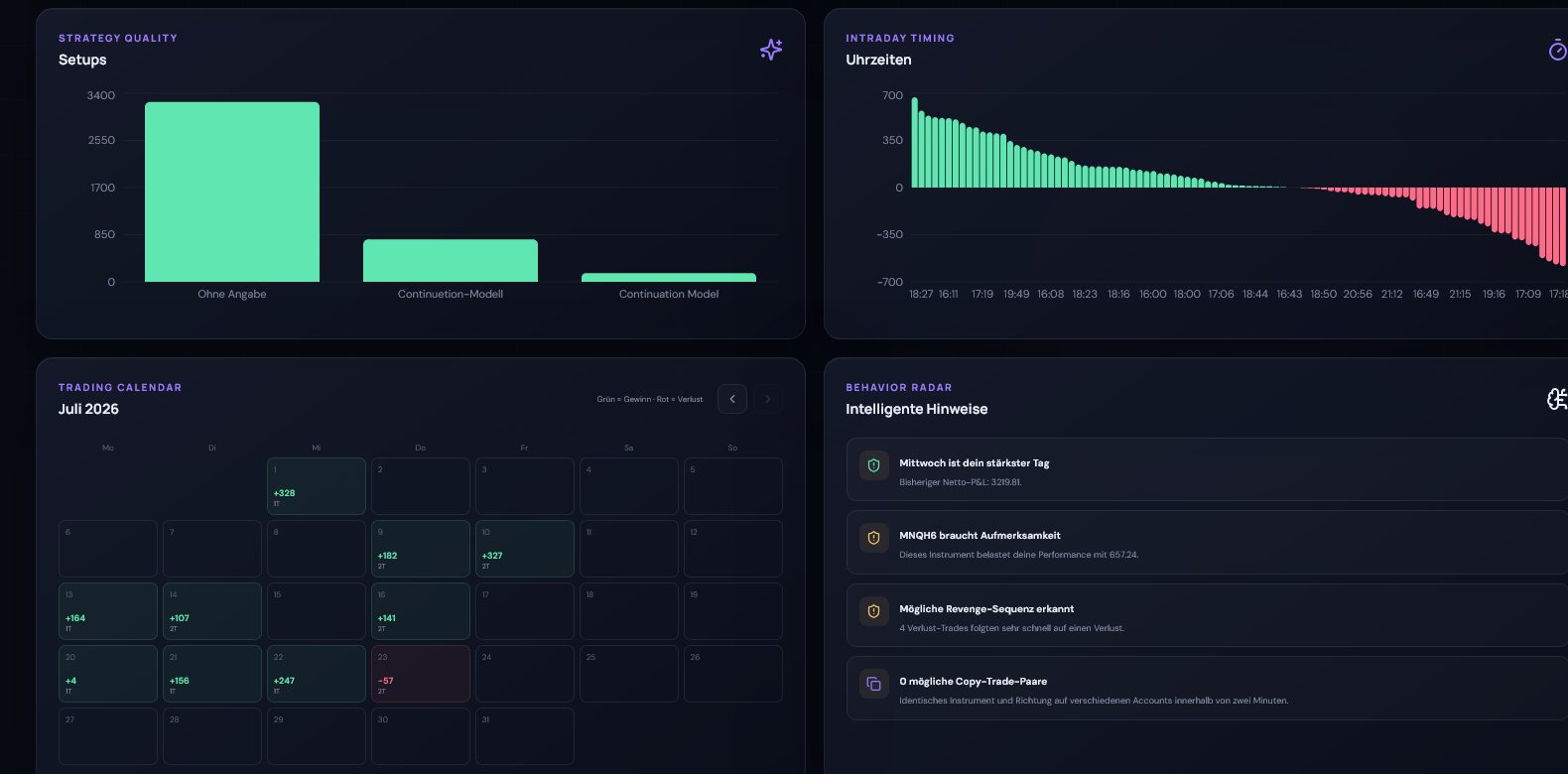
Behavior may still leave observable traces: less time to the next entry, larger size, more trades than planned, a setup switch or weaker rule adherence. These traces do not prove an emotion, but they make the hypothesis testable.
- Time from the first realized daily loss to the next entry
- Position size before and after the loss
- Number of additional trades in the same session
- Setup and playbook adherence after the loss
- Net outcome of later trades including fees
One futures study found more risk after losses
Joshua Coval and Tyler Shumway studied professional traders in the US Treasury bond futures pit at the Chicago Board of Trade. Traders with morning losses were more likely to assume above-average afternoon risk than traders with morning gains.
The finding matters, but it has limits. It concerns professional pit traders in a specific market and period. It does not prove that every modern retail trader overreaches after a loss, or that every fast re-entry is irrational.
Careful interpretationThe study provides a plausible hypothesis. Your own account history must show whether it applies to your process.
More activity can increase friction
Barber and Odean analyzed brokerage records for more than 60,000 US households. The most active groups earned materially weaker net returns than less active groups after transaction costs. The sample concerns equity investors rather than futures day traders, but it illustrates a general mechanism: more activity increases friction and may accompany overconfidence.
For a futures trader, the test is therefore not only whether more trades follow a loss. It is whether costs, quality and risk change at the same time.
| Observation | Possible hypothesis | What it does not prove |
|---|---|---|
| Size increases | The loss is being chased | That the larger trade was automatically bad |
| Re-entry after 30 seconds | Impulsive response | That no objective setup could exist |
| Setup changes | The original plan was abandoned | That the new approach never has an edge |
| Trade count rises | Overtrading | That all high-frequency trading is irrational |
Turn suspicion into a personal comparison
Split trading days into two groups: sessions with an early realized loss and comparable sessions without one. Then compare size, frequency, time to re-entry, fees and rule status—not only end-of-day P&L.
Keep account, session and market as stable as possible. Otherwise a quiet MES morning may be compared with a volatile NQ afternoon and the difference incorrectly attributed to emotion.
- Fix the account and timezone.
- Define the first realized daily loss consistently.
- Compare only later trades from the same session.
- Treat missing journal fields as missing evidence.
- Wait for several comparable cases before changing a rule.
A protective rule must be observable
“No revenge trading” is too vague to audit. A testable rule might be: after the first realized daily loss, pause for ten minutes, do not increase contract count and only re-enter with a documented playbook setup.
The value is not the exact ten-minute number. The value is that the rule can later be checked. Aether Ledger can relate entry intervals, size changes, loss sequences, documented rules and journal context without inventing an emotion from P&L.
Sources and further reading
The cited studies concern specific historical markets and participant groups. They support hypotheses, not diagnoses for individual traders.